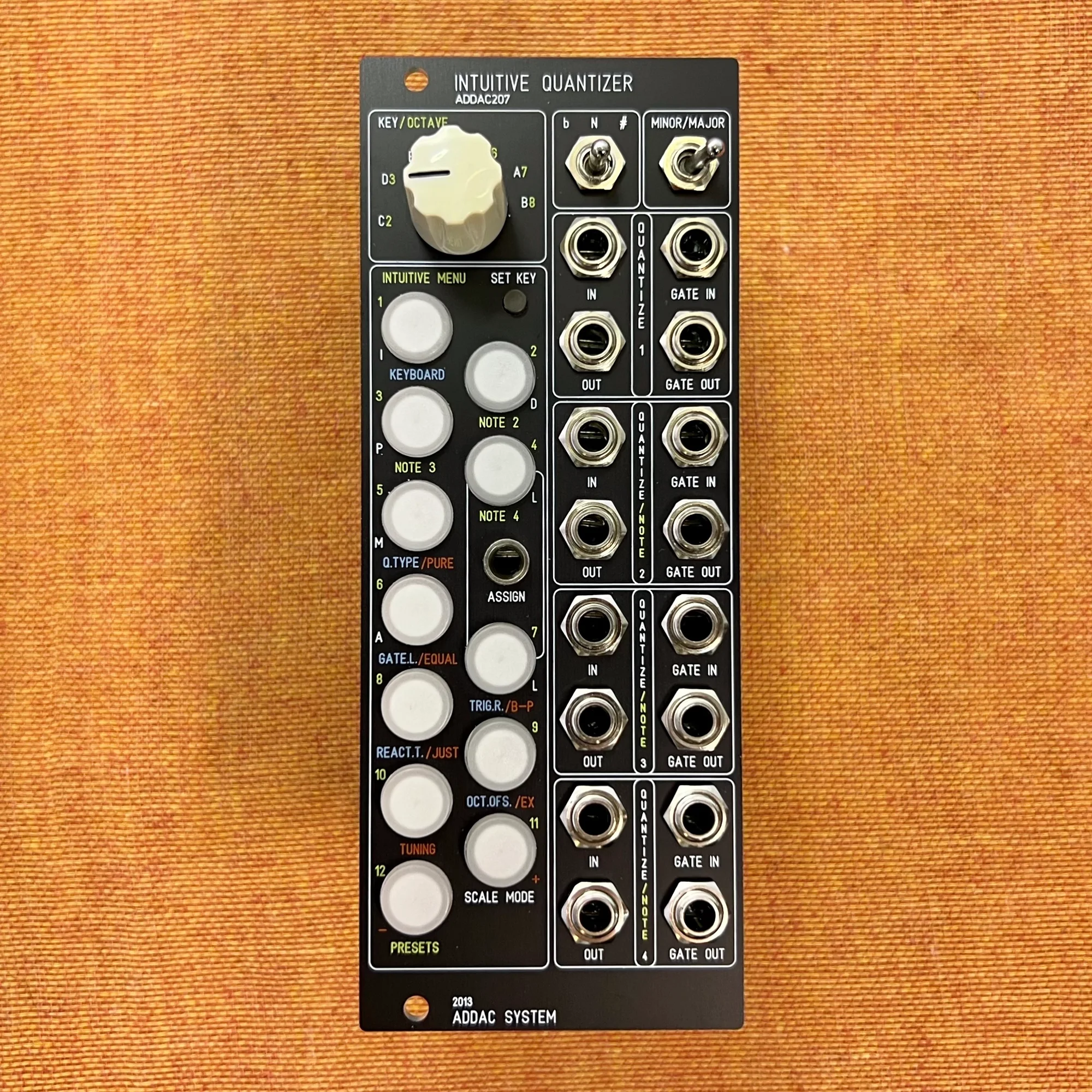
This is an introduction to the ADDAC207 Intuitive Quantizer by ADDAC System, available at Takazudo Modular.
The ADDAC207 Intuitive Quantizer is a 4-voice intuitively operated quantizer.
This product is available for purchase below.
- Manuals and Guides
- ADDAC207 Feature Overview
- The Appeal of the ADDAC207
- Reference Video
- Technical Specifications
- Included Accessories
- Product Warranty
Manuals and Guides
Takazudo Modular publishes manuals and guide articles for this product. Please see below.
ADDAC207 Feature Overview
This quantizer has an extensive set of features. Let me first list the ADDAC207's features in bullet points, then dive deeper into the key areas.
2 modes (Keyboard mode / Quantizer mode)
Sample & hold function via gate input/output
Custom scale definition capability
Definable note interval offsets for chord generation
3 quantization type settings (Above, Below, Ignore)
Configurable gate output length
Octave offset settings
Menu settings controllable via CV
5 different temperaments selectable including Bohlen-Pierce
Configurable octave ratio (e.g., changing 1V/Oct to 0.5V/Oct)
Save scales and settings to 11 user presets
The Appeal of the ADDAC207
Here are three points that I consider the standout qualities of this ADDAC207.
1. 4 Voices
The feature that anyone choosing this quantizer is certainly looking for is the ability to handle multiple voices. The ADDAC207 can handle up to 4 voices.
When you want to play multiple oscillators in a modular system, assuming a straightforward setup, you need to quantize the pitch sent to each oscillator individually. With the ADDAC207, this single module can handle all four of those quantizations. This is the first key convenience.
Among the modules we carry, the RYK Modular: Vector Wave is a multi-timbral oscillator module that receives four 1V/Oct signals and can assign a different oscillator to each of four pitches. While MIDI can also drive these 4 voices, the ADDAC207 pairs perfectly when you want to control 1V/Oct via analog CV input. (The separately sold Vector Wave Expander is required to receive four 1V/Oct inputs.)
Depending on the type of music you play, tonal harmony between notes may not always be critical. But when you do want to harmonize multiple oscillators playing different pitches, a module like the ADDAC207 is especially useful.
2. Performance-Friendly Size
The second point is that, in my personal opinion, this module has an interface sized for performance. Among quantizers, there are many very compact modules as small as 2HP. If you need 4 voices, you could argue that lining up four of those would be the same -- and even more compact.
However, if you're changing quantizer settings as part of a performance, modules that small would be difficult to operate. The ADDAC207's button layout is sized appropriately for operating the quantizer on the fly during performance.
3. Custom Scales and Chord Generation
The third point is the ease of setting custom scales and pitch interval offsets for chord generation. Many quantizer owners probably just set their favorite scale, feed in some CV or LFO, and leave it at that.
Personally, I believe one of the great appeals of a quantizer with customizable scales is the ability to explore pitch harmonies by operating the quantizer. For example, you might discover that within C major, narrowing to C-E-G-A-B creates your preferred harmonies, or that switching to C-D-E-A creates an interesting variation.
Using a sequencer and quantizer to operate a modular system this way gives me a strong sense of actually performing with a modular system. Points 2 and 3 are crucial for achieving this experience.
I feel this module was designed precisely for this kind of use, and the ADDAC207 lives up to its name -- Intuitive.
Combine multiple sequencers with this ADDAC207, send individual 1V/Oct signals to multiple VCOs, and apply separate VCA/Filter+Envelope to each audio out -- this will greatly expand your performance possibilities.
Reference Video
Below is a session video where I used this quantizer. CV from OXI ONE is received across 4 channels, and the quantized 1V/Oct output is sent to Vector Wave. The CVs are raised and lowered from the OXI ONE side, and I continuously change the active keys on the quantizer to match.
Technical Specifications
This is a module with considerable depth. Please check your case depth.
Width: 10HP
Depth: 52mm
Power consumption: max +140mA / -70mA
Included Accessories
Power ribbon cable
Screws
Product Warranty
This product carries a 2-year manufacturer warranty covering normal use under typical operating conditions. Please contact us if you notice any issues with the product.
About ADDAC System
ADDAC System is a modular synthesizer maker based in Portugal.
Their lineup is built on solid, no-nonsense modules that make the most of analog character. At the same time, they have released plenty of inventive modules that bring digital technology into the mix in a tasteful way — flexible CV-to-MIDI converters, deeply controllable granular processors, and more.

Bonus: Modular Accessory Set by 電氣美術研究會 (Denki Bijutsu Kenkyukai) Included
In the hope that more people will get hands-on with modular synths, we have teamed up with 電氣美術研究會 to bundle a modular accessory set with this product.
The contents vary by season — patch cables, power cables, a dress-nut sample set, a mono splitter, and more. The set is included with the product, so please give it a try!
That concludes the introduction to the ADDAC207 Intuitive Quantizer.
This module was what first led me to discover ADDAC System. I was searching for exactly this kind of quantizer and found this module, which was precisely what I was looking for. Personally, quantizers are among my favorite category of modules, and the ADDAC207 is one I especially recommend.
We hope you found this helpful.