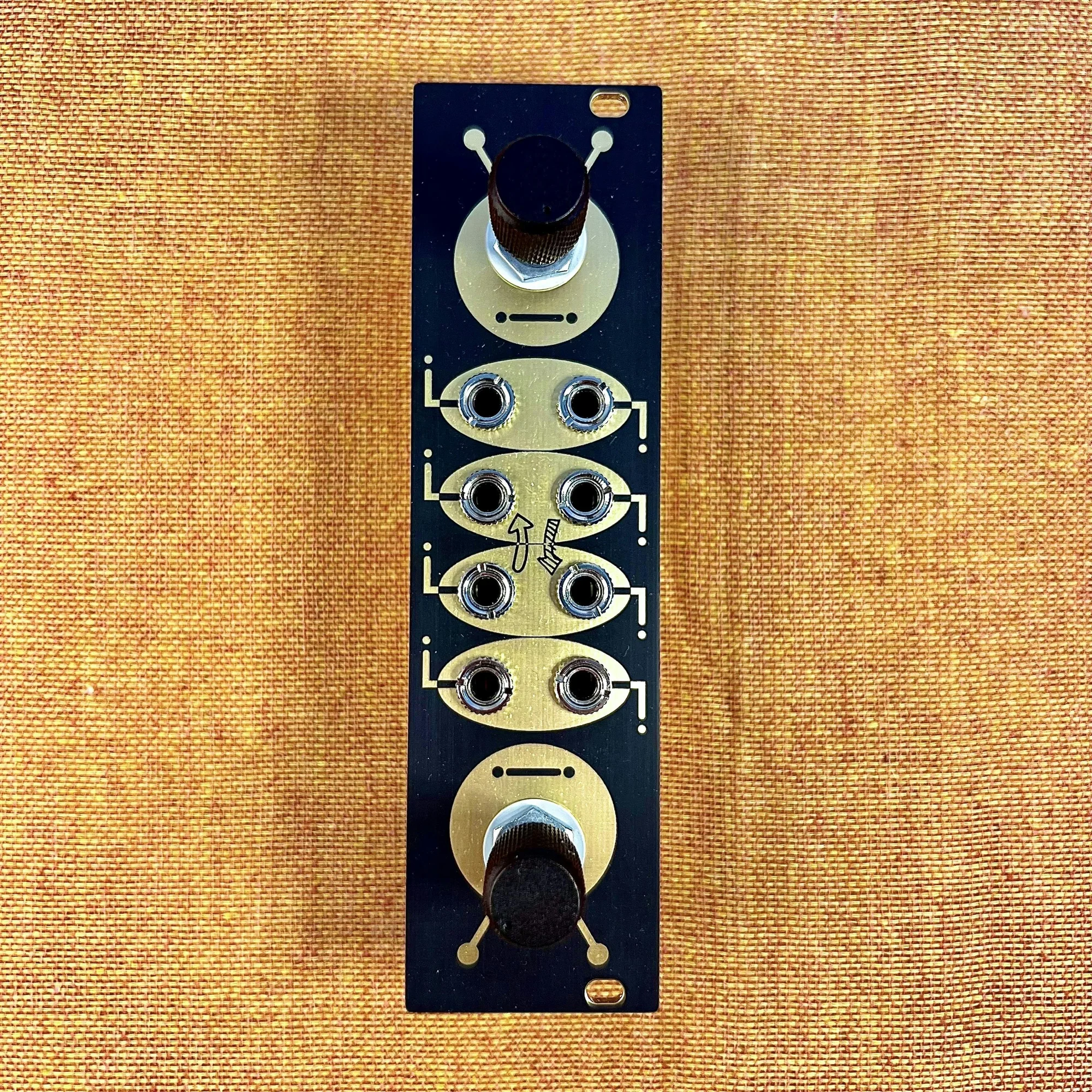
This is an introduction to the DSV by Meng Qi, available at Takazudo Modular.
DSV is a module that attenuates stereo (2x mono) signals.
This product is available for purchase below.
- What Kind of Module is DSV?
- Example 1: Volume Control for Modules with Stereo Output
- Example 2: As an Attenuator for LFO or Envelope
- Ergonomic Knobs
- Other Notes
- Technical Specifications
- Included Accessories
What Kind of Module is DSV?
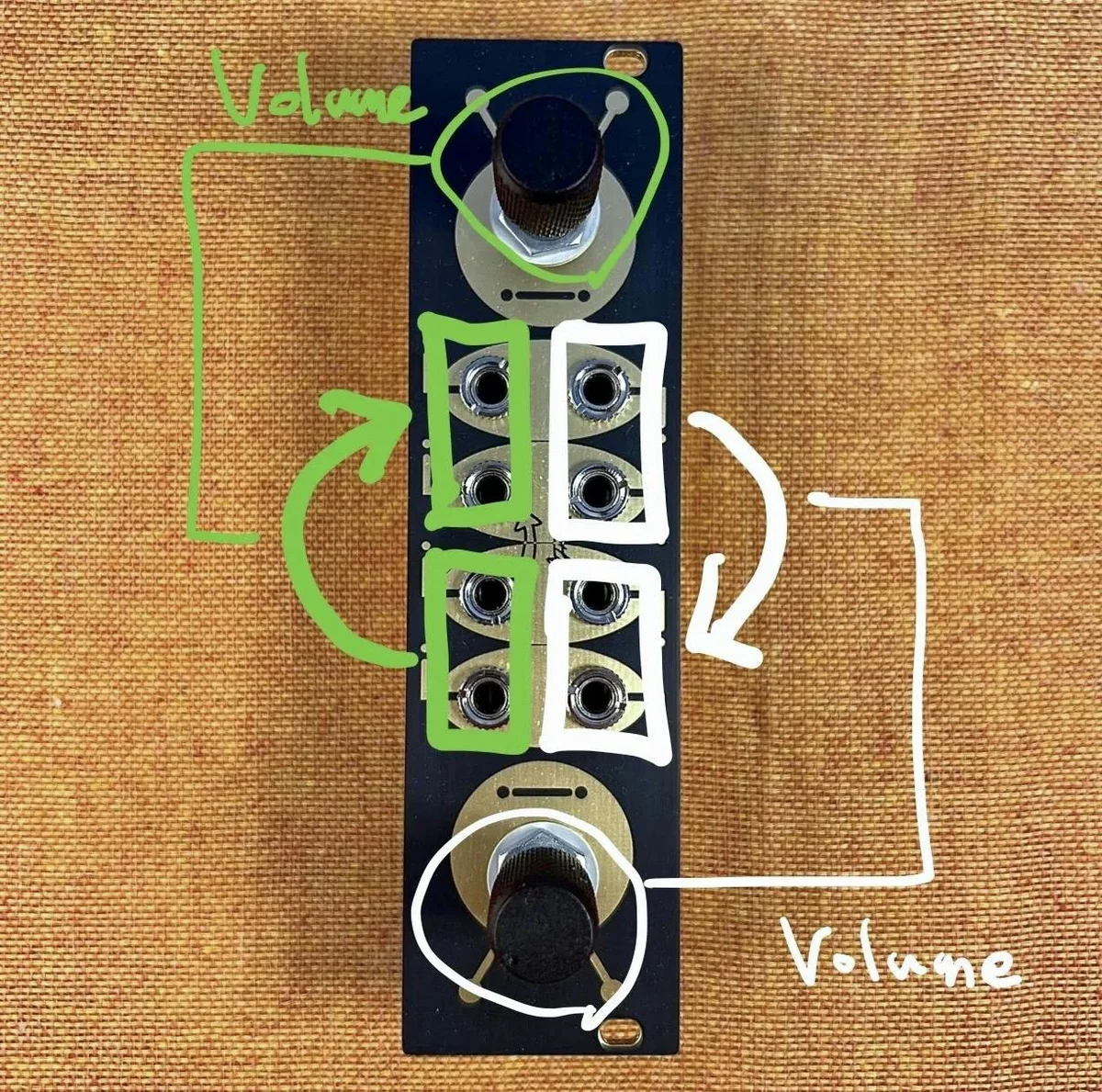
DSV stands for Dual Stereo Volume — a passive module with two pairs of stereo volume controls. The right jacks are controlled by the bottom knob, and the left jacks by the top knob. Each pair attenuates the signal received at its input jack and passes it to the output jack.
Although called stereo, each jack is mono. This module attenuates two mono inputs simultaneously with a single knob.
That's all this module does. If your modular system ultimately routes signals to some kind of stereo mixer, you may not even need it.
This module is useful when you want to insert volume control between modules, or when you need to attenuate CV signals.
Example 1: Volume Control for Modules with Stereo Output
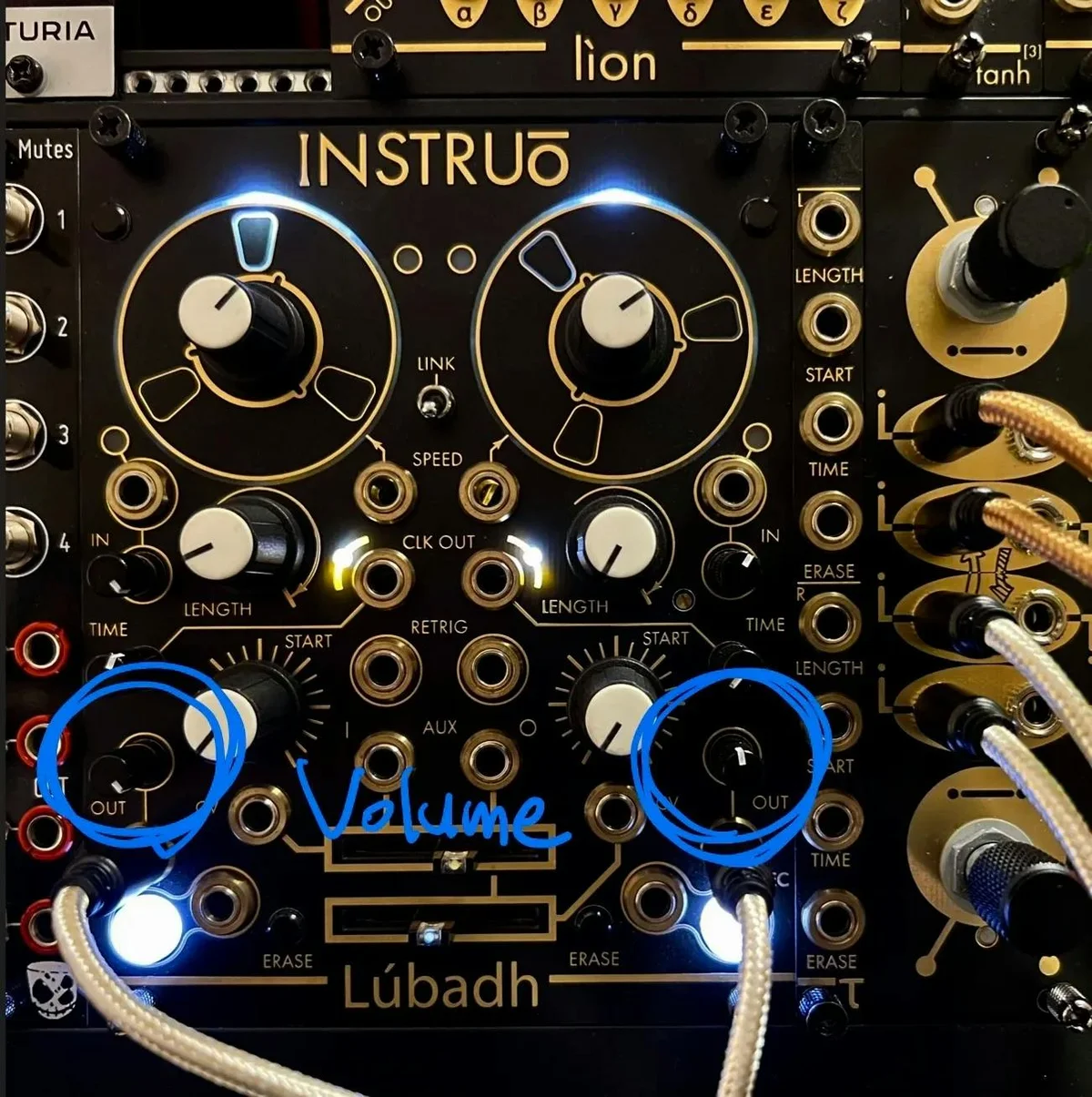
For example, there's a module called Lúbadh from Instruo. It's a module with two tape simulator decks that outputs two audio signals. It has small volume knobs for each deck to control their output levels.
Lúbadh has many versatile tape functions (too many to detail here), but one use case is running both decks as a stereo delay.
When using Lúbadh this way, adjusting the volume of both Audio Out jacks requires simultaneously turning two small knobs. In such cases, placing DSV next to it and routing the Audio Outs through DSV's inputs lets you comfortably control volume with the large knobs.
Example 2: As an Attenuator for LFO or Envelope
DSV can also be used as a CV attenuator. By inputting LFO or Envelope signals, you can simultaneously attenuate two CV signals.
Of course, using only one side, it works as a simple mono attenuator.
Ergonomic Knobs
DSV features large, heavy knobs that are easy to operate.
In a modular system, knobs and faders serve as the module's interface, and during live performances, whether a module's knobs are the right size for your needs isn't always obvious.
Personally, I believe that the size of knobs, buttons, and faders is an important factor in playing modular synthesizers. When first starting out, you might think smaller modules are conveniently compact, but once they're all lined up, you may find that modules with adequately sized knobs are actually more comfortable to use.
This is a matter of individual feel, but in a system of moderate size, it's a module that comes in handy whenever you need to insert volume or CV control.
Other Notes
The gold and black texture is also quite nice. The insect(?)-like design is cute. Honestly, I stocked it partly because the look was charming. The unique appearance and gold luxury feel add nice flair when lined up with other modules.
Technical Specifications
ALPS stereo potentiometers
Passive module
Width: 7HP
Depth: 26mm
Included Accessories
Screws
Meng Qi sticker
About Meng Qi
Meng Qi is an electronic instrument designer based in Beijing, China.
Every instrument he makes is one of a kind. His work blends the analog and the digital with a real sense of playfulness, never losing sight of what makes something feel like a physical instrument — exactly the kind of thing that keeps electronic music enthusiasts coming back for more.

Bonus: Modular Accessory Set by 電氣美術研究會 (Denki Bijutsu Kenkyukai) Included
In the hope that more people will get hands-on with modular synths, we have teamed up with 電氣美術研究會 to bundle a modular accessory set with this product.
The contents vary by season — patch cables, power cables, a dress-nut sample set, a mono splitter, and more. The set is included with the product, so please give it a try!
That concludes our introduction of DSV.
We hope you find this helpful.